Andrew Mishlove co-authored Wisconsin OWI Defense, the first and only OWI/DUI textbook for Wisconsin lawyers, now in its second edition. Behind it stand four decades of practice and more than 400 jury trials.
We are the only firm in Wisconsin, and one of a handful in America, that can re-analyze the raw computer files from the state's blood-testing machine. That is where a .236 result can become a dismissal.
Andrew Mishlove and Lauren Stuckert are the only board-certified OWI/DUI specialists in Wisconsin. Andrew was elected to the board that grants the certification; Lauren was the youngest attorney in America ever to earn it.
Attorney Andrew Mishlove literally wrote the textbook on OWI defense in Wisconsin. "Wisconsin OWI Defense, the Law and Practice" by Mishlove and Nesci is the must-have textbook that Wisconsin lawyers use in drunk driving defense. Andrew Mishlove is Wisconsin's first board-certified DUI defense specialist, and in 2011, he was elected to a seat on the board itself. He is a frequent speaker at conferences and courses all over the country, where lawyers are taught how to defend drunk driving cases.
Attorney Lauren Stuckert is also a board-certified DUI defense specialist. She was the youngest lawyer in America ever to achieve this distinction. She was also the first criminal defense attorney in Wisconsin to receive a certificate in Forensic Chromatography Blood Alcohol Analysis.
No Wisconsin law firm has more experience, more knowledge, or a better history of success when it comes to DUI defense than Mishlove and Stuckert, LLC. Over their combined five decades of experience, our DUI attorneys have built an impressive portfolio of success stories. We handle all sorts of OWI/DWI/DUI cases, including cases involving minors in the vehicle, marijuana DUIs, DUIs involving personal injuries, commercial driver DUIs, and DUI homicides.
What You Should Know
Andrew Mishlove, our OWI defense attorney, describes what to expect if you're pulled over on suspicion of drunk driving in Wisconsin. You will be required to identify yourself with your license, registration, and proof of insurance, but otherwise, you have the right to remain silent and refuse any testing. The very best thing you can do for yourself if you've been pulled over on suspicion is to call the attorneys at Mishlove and Stuckert as soon as possible.
What You Should Know
While many states use the terms "DUI" or "DWI" to refer to driving under the influence of alcohol or a controlled substance, Wisconsin uses the term "OWI," which stands for "operating while intoxicated." This means that in our state, just turning on your vehicle while under the influence can lead to an OWI charge. At Mishlove and Stuckert, LLC, you'll find Wisconsin's only true certified impaired driving defense attorneys: put our team to work in your favor starting with a free consultation.
First Steps to Take
Even though being stopped by the police can be scary and frustrating, you need to stay polite and calm. Lashing out or being rude to a police officer will not help your case; in fact, it will be used as evidence against you. It may give your prosecutor an excuse to seek the harshest charges possible, so do not argue with the police, insult the police, lie to the police, or try to talk your way out of it. Simply be polite and calm.
Typically, the police officer who pulled you over will ask you to take a series of field sobriety tests. In Wisconsin, you are not required to take these tests in the field unless you are working as a commercial driver. If you refuse to take the tests, make sure to do so in a polite and calm manner. However, understand that the fact that you refused to do the field exercises may be used as evidence against you in court, just as your performance on these exercises may also be used as evidence.
There are driver’s license penalties if you refuse to submit to a breath or blood test. In first-offense situations, these penalties may be harsher than the OWI/DUI case itself. If the case is a second or subsequent offense, if someone was injured, or if there was a minor in your car, the matter may be criminal. In that situation, if you refuse to give a breath or blood sample, you will be facing the extra driver’s license penalties, and it is still very likely that the police will take your blood anyway, usually with a warrant.
Andrew Mishlove explains the three levels of field sobriety training that police officers across the nation receive. Our Wisconsin DUI defense attorneys have also taken this coursework, and they teach what they've learned to other defense attorneys as well. We understand the procedures and protocols and can identify when police violate them.
The right to talk to an attorney is triggered by something called a “custodial interrogation.” Simply put, that means being questioned after an arrest. An arrest is not the initial stop and detention, but the point where you are cuffed and put in the back of the squad car. Courts have also held that an interrogation requires verbal questions that call for verbal answers.
This means neither the field sobriety exercises nor the chemical test procedure are interrogations. Many times, when people are asked to consent to a breath or blood test, they want to talk to an attorney. Unless the police are conducting a custodial interrogation, the right to an attorney does not yet apply.
Usually in Wisconsin, after the breath or blood is taken, the police go through a procedure called the Alcohol Influence Report. This is a custodial interrogation that requires a Miranda warning. At this point, it is best to refuse to answer any questions.
If the police follow the OWI/DUI procedure correctly, the right to an attorney is triggered after the breath or blood test. Sometimes, however, the police will start asking questions after arrest, but prior to the breath or blood test. This might trigger an earlier right to an attorney.
It takes a knowledgeable DUI lawyer to evaluate these situations.
Andrew Mishlove, our OWI defense attorney, describes what to expect if you're pulled over on suspicion of drunk driving in Wisconsin. You will be required to identify yourself with your license, registration, and proof of insurance, but otherwise, you have the right to remain silent and refuse any testing. The very best thing you can do for yourself if you've been pulled over on suspicion is to call the attorneys at Mishlove and Stuckert as soon as possible.
There are several types of OWI/DUI charges in Wisconsin. Our specialized attorneys can walk you through all the details and have provided some important basics below.
Your driver's license can be revoked for six to nine months and you may have to complete treatment courses or a driver's safety plan. A conviction for your first DUI can cost approximately $800 in fines and additional court costs. If your BAC level is 0.15 or higher after you submit to a chemical test of your breath or blood, you face a one-year ignition interlock device order (IID).
If you receive a conviction for a second DUI in Wisconsin, you can face five days to six months in jail. Your license will be revoked for 12 to 18 months. Alcohol assessment and treatment are mandatory, in addition to having an IID installed.
The penalties and consequences in conviction of a third DUI are substantial, resulting in a minimum of 45 days in jail to a maximum one-year jail sentence. Your license will be revoked for a minimum of 24 months and have an IID in your vehicle for at least a year. If your BAC level is between 0.08 to 0.16, your fines will range from $600 to $2,000. If your BAC level was .17 or higher, your fine amounts can rise to as high as $8,000.
Your fines for a fourth DUI can range from $600 to $10,000. If your BAC level is 0.17 or higher, your fines can be doubled, tripled, or quadrupled. You will face a minimum 60-day jail sentence, with a maximum jail sentence of six years. Your license will be revoked for four to six years, plus the confinement period. All fourth DUI offenses are considered felonies in Wisconsin, resulting in the loss of several rights even after the completion of your jail sentence.
Wisconsin has a zero-tolerance stance against drivers under the influence of drugs. Any detectable amount of marijuana or controlled substance like cocaine in your system can result in an OWI charge. You can also be charged with an OWI for operating a vehicle after taking function-impairing prescription medications or cough syrup.
If you cause an injury while driving under the influence of alcohol or drugs, your license will be revoked and you can spend up to a year in prison. You will be fined $2,000 plus significant court costs. If you are convicted of a first offense, felony OWI/DUI - Causing Great Bodily Harm, you can be sentenced to 12.5 years in jail and subject to fines of up to $25,000. You will also have a lifetime CDL disqualification for offenses committed while operating a commercial vehicle.
A DUI homicide can be considered a Class D Felony or Class C Felony. Both classes of felony carry a minimum five-year prison sentence. A Class D felony can result in up to 25 years in prison and up to $100,000 in fines. A Class C felony can result in up to 40 years in prison and up to $100,000 in fines.
At Mishlove and Stuckert, LLC, we have won many cases that other lawyers thought were hopeless. With over fifty years of experience, we have helped people keep their licenses, avoid jail, and avoid an ignition interlock device. We may be able to have your charges reduced or even dismissed completely. As we build the right defense, you may avoid jail time, fines, a criminal record, and you may even protect your license.
Read seven key factors in winning a drunk driving case in Wisconsin to learn more about the defenses available to you.
Remember: the police, medical technicians, and even laboratory analysts make investigation errors. We have the know-how to evaluate and discover these errors.
Many people believe that blood test results cannot be challenged. Unfortunately, many DUI lawyers do not know how to even review blood test laboratory records to see whether the test was performed correctly.
Mishlove and Stuckert are different. They have unmatched training, skill, and experience in the methods used to test blood. We review the lab records in every single case.
We are the only law firm in the state, and one of only a handful of law firms in America, that has the ability to re-analyze computer files created by the state’s blood test machine. We have the highest level of training in blood test chemistry, and we teach blood testing to other lawyers from all over America. Our attorneys know that false blood test results can happen from a bad blood draw, an improperly handled sample, a poorly calibrated blood test device, human error, and many other reasons.
OWI stands for “operating while intoxicated.” It is the term used in Wisconsin; most other states use “driving under the influence” (DUI) or “driving while intoxicated" (DWI).
As soon as you’re under arrest, the best thing you can do is remain polite and calm throughout the entire process. You will be given a chance to contact a DUI defense attorney, and you should do so as soon as you can. Be advised: Wisconsin DUI laws are tough. You need an expert lawyer who can start building a defense while the case facts are fresh. Typically, the sooner you get qualified legal help, the stronger your case may be.
Absolutely not! For the best possible outcome, choose a lawyer who understands the complex nature of the laws applicable to OWI, DWI, and DUI defense. While no lawyer can guarantee the outcome in your case, selecting expert Wisconsin DUI lawyers Andrew Mishlove or Lauren Stuckert can considerably improve your chances of achieving a win in your case and of keeping your criminal record clean. We are experienced in defending breath tests, blood tests, DUI with drugs, DUI injury cases, and DUI homicides.
You have the constitutional right to refuse a field sobriety test; however, police officers will consider your refusal an indicator of guilt. If you refuse the test, the most likely outcome is that you will be arrested.
Mishlove & Stuckert, LLC Attorneys at Law has been rated the #1 OWI/DUI law firm in the state by Wisconsin Law Journal Reader Rankings. Our OWI/DUI specialists have been highly rated by organizations including:
To speak with one of our board-certified OWI/DUI defense specialists, request a consultation online or call us at (414) 332-3499.
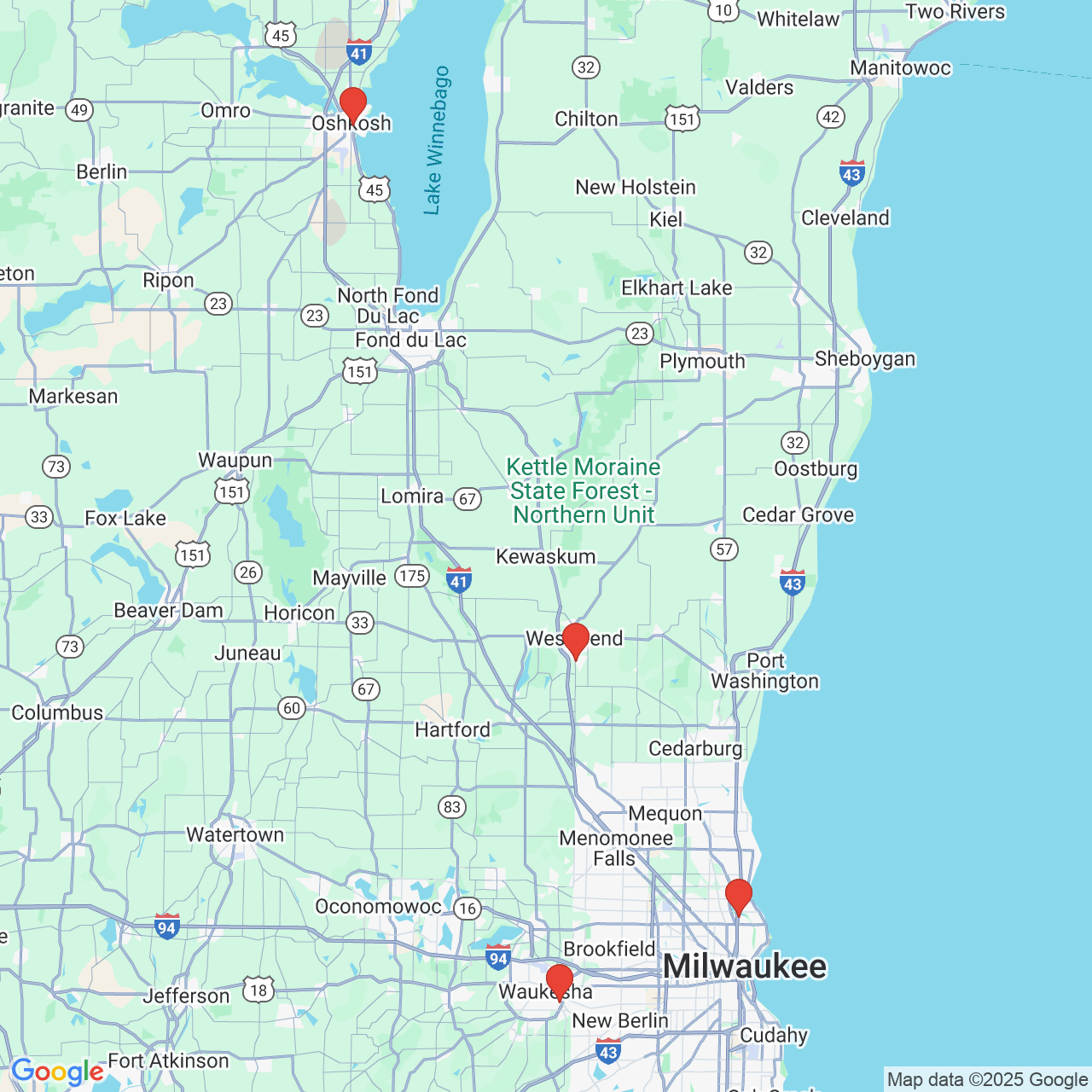
Locations
We have 4 locations in Wisconsin.
"Mr. Mishlove was worth every penny and then some. I would consider him the Michelangelo of the DUI defense world.
He is professional, dedicated, and pours his heart into his job. I would give him 10 stars if I could." Ronald S.